924.尽量减少恶意软件的传播

目标

给出了一个由 n 个节点组成的网络,用 n × n 个邻接矩阵图 graph 表示。在节点网络中,当 graph[i][j] = 1 时,表示节点 i 能够直接连接到另一个节点 j。

一些节点 initial 最初被恶意软件感染。只要两个节点直接连接,且其中至少一个节点受到恶意软件的感染,那么两个节点都将被恶意软件感染。这种恶意软件的传播将继续,直到没有更多的节点可以被这种方式感染。

假设 M(initial) 是在恶意软件停止传播之后,整个网络中感染恶意软件的最终节点数。

如果从 initial 中移除某一节点能够最小化 M(initial), 返回该节点。如果有多个节点满足条件,就返回索引最小的节点。

请注意,如果某个节点已从受感染节点的列表 initial 中删除,它以后仍有可能因恶意软件传播而受到感染。

示例 1:

输入:graph = [[1,1,0],[1,1,0],[0,0,1]], initial = [0,1]
输出:0

示例 2:

输入:graph = [[1,0,0],[0,1,0],[0,0,1]], initial = [0,2]
输出:0

示例 3:

输入:graph = [[1,1,1],[1,1,1],[1,1,1]], initial = [1,2]
输出:1

说明:

  • n == graph.length
  • n == graph[i].length
  • 2 <= n <= 300
  • graph[i][j] == 0 或 1.
  • graph[i][j] == graph[j][i]
  • graph[i][i] == 1
  • 1 <= initial.length <= n
  • 0 <= initial[i] <= n - 1
  • initial 中所有整数均不重复

思路

初始 已感染恶意软件的节点集合中去掉一个节点使得整个网络的感染节点数量最小,返回这个节点。注意,从初始被感染的集合中去除,并不代表后续不会再被感染。如果还有与它连通的恶意节点,那么仍会被感染,最终计算感染节点时要算上。

因此,如果被感染节点是连通的,去掉任一感染节点后,总的感染节点数量不会改变。这时需要将索引最小的节点返回。

刚开始的想法是先排除相互的连通的感染节点,然后取剩余节点中连接节点个数最多的那个。

这个想法没错,但是具体实现的时候,仅仅判断直接相连的两个节点是否同时在感染列表显然是不对的,因为存在间接连接的情况。并且直接从感染集合移除还好影响后续其它节点的判断。

于是想到了使用并查集。

官网的解法类似,将连通的节点染成同一颜色,然后在感染节点中看是否有颜色唯一的节点,即该连通区域中只有一个感染节点,然后找出连通区域节点数最大的,如果有多个颜色唯一节点,返回下标最小的。如果没有颜色唯一的节点,那么移除任一感染节点,总的感染数都不会减少,直接取下标最小的即可。

判断区域是否连通可以使用并查集,也可以使用深度优先搜索。

代码

/**
 * @date 2024-04-16 8:29
 */
public class MinMalwareSpread924 {

    public int[] u;
    TreeSet<Integer> s;
    HashSet<Integer> d = new HashSet<>();

    public void merge(int x, int y) {
        HashSet<Integer> tmp = new HashSet<>();
        int rx = find(x, tmp);
        int ry = find(y, tmp);
        d.addAll(tmp);
        if (s.contains(rx) && s.contains(ry)) {
            if (rx > ry) {
                u[rx] = ry;
            } else if (rx < ry) {
                u[ry] = rx;
            }
        } else if (s.contains(ry)) {
            u[rx] = ry;
        } else {
            u[ry] = rx;
        }
    }

    public int find(int x, HashSet<Integer> tmp) {
        if (x != u[x]) {
            if (s.contains(x) && s.contains(u[x])) {
                tmp.add(x);
                tmp.add(u[x]);
            }
            x = find(u[x], tmp);
        }
        return u[x];
    }

    public int find(int x) {
        if (x != u[x]) {
            x = find(u[x]);
        }
        return u[x];
    }

    public int count(int x) {
        int cnt = 0;
        int rt = find(x);
        for (int i = 0; i < u.length; i++) {
            if (rt == find(i)) {
                cnt++;
            }
        }
        return cnt;
    }

    public int minMalwareSpread(int[][] graph, int[] initial) {
        int n = graph.length;
        List<Integer>[] g = new ArrayList[n];
        u = new int[n];
        for (int i = 0; i < n; i++) {
            g[i] = new ArrayList<>(n);
            u[i] = i;
        }

        s = new TreeSet<>();
        for (int i : initial) {
            s.add(i);
        }
        int res = s.first();
        for (int i = 0; i < n; i++) {
            for (int j = 0; j < n; j++) {
                if (graph[i][j] == 1) {
                    g[i].add(j);
                    merge(i, j);
                }
            }
        }
        if (s.size() == d.size()) {
            return res;
        }
        TreeSet<Integer> ini = new TreeSet<>((x, y) -> count(y) - count(x) == 0 ? x - y : count(y) - count(x));
        for (int i : initial) {
            if (!d.contains(i)) {
                ini.add(i);
            }
        }

        return ini.first();
    }

}

性能

2924.找到冠军II

目标

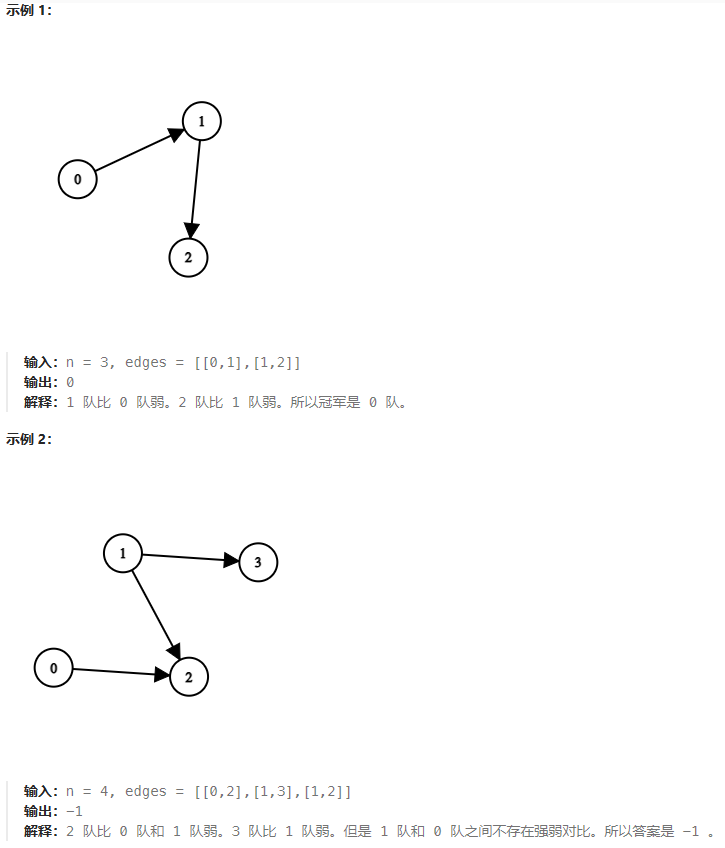
一场比赛中共有 n 支队伍,按从 0 到 n - 1 编号。每支队伍也是 有向无环图(DAG, Directed Acyclic Graph) 上的一个节点。

给你一个整数 n 和一个下标从 0 开始、长度为 m 的二维整数数组 edges 表示这个有向无环图,其中 edges[i] = [ui, vi] 表示图中存在一条从 ui 队到 vi 队的有向边。

从 a 队到 b 队的有向边意味着 a 队比 b 队 强 ,也就是 b 队比 a 队 弱 。

在这场比赛中,如果不存在某支强于 a 队的队伍,则认为 a 队将会是 冠军 。

如果这场比赛存在 唯一 一个冠军,则返回将会成为冠军的队伍。否则,返回 -1 。

注意:

是形如 a1, a2, ..., an, an+1 的一个序列,且满足:节点 a1 与节点 an+1 是同一个节点;节点 a1, a2, ..., an 互不相同;对于范围 [1, n] 中的每个 i ,均存在一条从节点 ai 到节点 ai+1 的有向边。

有向无环图 是不存在任何环的有向图。

说明:

  • 1 <= n <= 100
  • m == edges.length
  • 0 <= m <= n * (n - 1) / 2
  • edges[i].length == 2
  • 0 <= edge[i][j] <= n - 1
  • edges[i][0] != edges[i][1]
  • 生成的输入满足:如果 a 队比 b 队强,就不存在 b 队比 a 队强
  • 生成的输入满足:如果 a 队比 b 队强,b 队比 c 队强,那么 a 队比 c 队强

思路

如果只有一个节点,那它就是冠军。入度非0的不是冠军。多个没有强弱关系的的节点,返回-1,例如,n=2,边为空。

只需计算没有被标记为weaker节点的index,如果多于1个返回-1。

代码

/**
 * @date 2024-04-13 19:22
 */
public class FindChampion2924 {
    public int findChampion(int n, int[][] edges) {
        boolean[] weaker = new boolean[n];
        for (int[] edge : edges) {
            weaker[edge[1]] = true;
        }
        int championIndex = -1;
        for (int i = 0; i < weaker.length; i++) {
            if (weaker[i]) {
                continue;
            }
            if (championIndex != -1) {
                return -1;
            }
            championIndex = i;
        }
        return championIndex;
    }
}

性能

2192.有向无环图中一个节点的所有祖先

目标

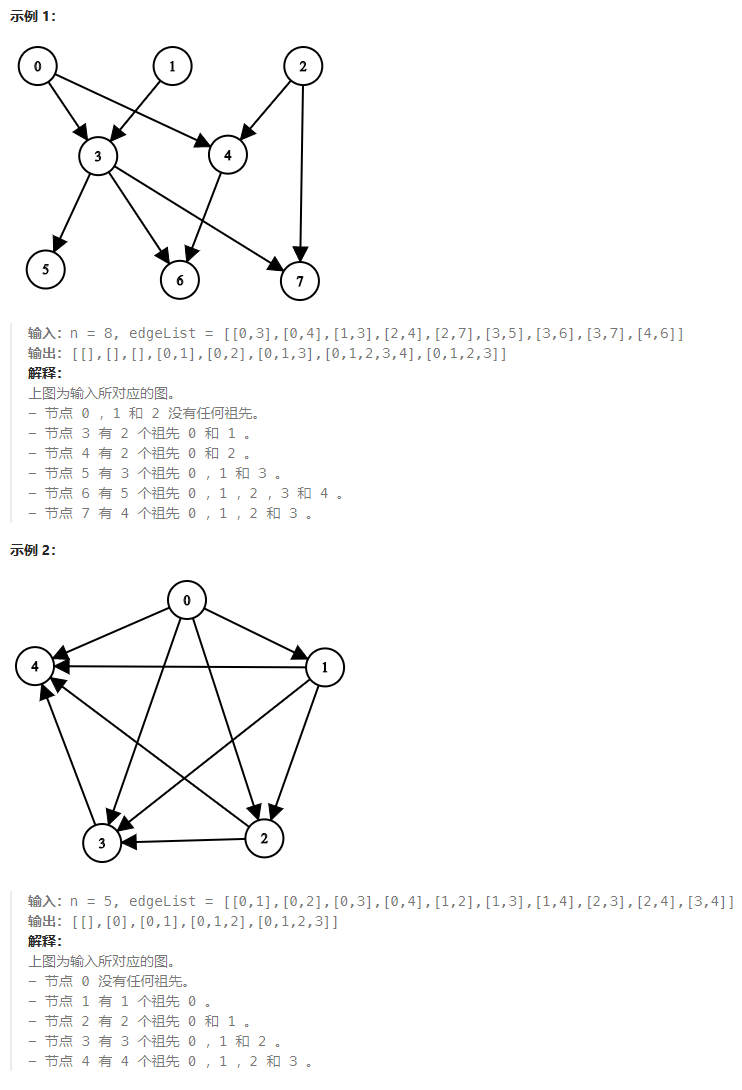
给你一个正整数 n ,它表示一个 有向无环图 中节点的数目,节点编号为 0 到 n - 1 (包括两者)。

给你一个二维整数数组 edges ,其中 edges[i] = [fromi, toi] 表示图中一条从 fromi 到 toi 的单向边。

请你返回一个数组 answer,其中 answer[i]是第 i 个节点的所有 祖先 ,这些祖先节点 升序 排序。

如果 u 通过一系列边,能够到达 v ,那么我们称节点 u 是节点 v 的 祖先 节点。

说明:

  • 1 <= n <= 1000
  • 0 <= edges.length <= min(2000, n * (n - 1) / 2)
  • edges[i].length == 2
  • 0 <= fromi, toi <= n - 1
  • fromi != toi
  • 图中不会有重边。
  • 图是 有向 且 无环 的。

思路

这个题要求所有节点的祖先节点集合,最直接的想法就是广度遍历然后记录父节点,然后下一个节点的祖先节点就是其父节点加上父节点的祖先节点。

需要注意的点是图不一定连通,所以选定一个起点不一定能遍历到所有节点。如果直接将所有节点加入队列容易超时。解决方法是先找到没有父节点的根节点,然后再广度遍历。

如果节点已经在队列中就不需要重复放入队列了,因为该节点的祖先集合可以由队列中的节点一起更新。

代码

/**
 * @date 2024-04-04 21:49
 */
public class GetAncestors2192 {

    /** 先找出没有parent的节点放入队列,然后广度优先遍历即可*/
    public List<List<Integer>> getAncestors(int n, int[][] edges) {
        List<Integer>[] g = new ArrayList[n];
        Set<Integer>[] dp = new TreeSet[n];
        List<List<Integer>> res = new ArrayList<>(n);
        Deque<Integer> q = new ArrayDeque<>();
        boolean[] hasParent = new boolean[n];
        for (int i = 0; i < g.length; i++) {
            g[i] = new ArrayList<>();
            dp[i] = new TreeSet<>();
        }
        for (int[] edge : edges) {
            g[edge[0]].add(edge[1]);
            hasParent[edge[1]] = true;
        }
        for (int i = 0; i < hasParent.length; i++) {
            if (!hasParent[i]) {
                q.offer(i);
            }
        }
        while (!q.isEmpty()) {
            Integer from = q.poll();
            for (int i = 0; i < g[from].size(); i++) {
                dp[g[from].get(i)].addAll(dp[from]);
                dp[g[from].get(i)].add(from);
                if (!q.contains(g[from].get(i))) {
                    q.offer(g[from].get(i));
                }
            }
        }
        for (Set<Integer> integers : dp) {
            res.add(new ArrayList<>(integers));
        }
        return res;
    }
}

性能

勉强过关,官网还介绍了拓扑排序的方法,有机会再更新吧。

2642.设计可以求最短路径的图类

目标

给你一个有 n 个节点的 有向带权 图,节点编号为 0 到 n - 1 。图中的初始边用数组 edges 表示,其中 edges[i] = [fromi, toi, edgeCosti] 表示从 fromi 到 toi 有一条代价为 edgeCosti 的边。

请你实现一个 Graph 类:

  • Graph(int n, int[][] edges) 初始化图有 n 个节点,并输入初始边。
  • addEdge(int[] edge) 向边集中添加一条边,其中 edge = [from, to, edgeCost] 。数据保证添加这条边之前对应的两个节点之间没有有向边。
  • int shortestPath(int node1, int node2) 返回从节点 node1 到 node2 的路径 最小 代价。如果路径不存在,返回 -1 。一条路径的代价是路径中所有边代价之和。

示例 1:

输入:
["Graph", "shortestPath", "shortestPath", "addEdge", "shortestPath"]
[[4, [[0, 2, 5], [0, 1, 2], [1, 2, 1], [3, 0, 3]]], [3, 2], [0, 3], [[1, 3, 4]], [0, 3]]
输出:
[null, 6, -1, null, 6]

解释:
Graph g = new Graph(4, [[0, 2, 5], [0, 1, 2], [1, 2, 1], [3, 0, 3]]);
g.shortestPath(3, 2); // 返回 6 。从 3 到 2 的最短路径如第一幅图所示:3 -> 0 -> 1 -> 2 ,总代价为 3 + 2 + 1 = 6 。
g.shortestPath(0, 3); // 返回 -1 。没有从 0 到 3 的路径。
g.addEdge([1, 3, 4]); // 添加一条节点 1 到节点 3 的边,得到第二幅图。
g.shortestPath(0, 3); // 返回 6 。从 0 到 3 的最短路径为 0 -> 1 -> 3 ,总代价为 2 + 4 = 6 。

说明:

  • 1 <= n <= 100
  • 0 <= edges.length <= n * (n - 1)
  • edges[i].length == edge.length == 3
  • 0 <= fromi, toi, from, to, node1, node2 <= n - 1
  • 1 <= edgeCosti, edgeCost <= 10^6
  • 图中任何时候都不会有重边和自环。
  • 调用 addEdge 至多 100 次。
  • 调用 shortestPath 至多 100 次。

思路

今天又手写了一遍Dijkstra算法,虽然通过了,但是性能差好多。对照着官网题解研究了一会,我也想把一些优化的点表达出来,但还是感觉没有理解透彻。又看了耗时最少的题解一脸懵,也看到了网友讲解的朴素 Dijkstra算法,有机会再研究补上吧。

代码

/**
 * @date 2024-03-26 8:35
 */
public class Graph {

    private final ArrayList<int[]>[] g;

    private PriorityQueue<int[]> q;

    private int[] dp;

    private int n;

    public Graph(int n, int[][] edges) {
        g = new ArrayList[n];
        for (int i = 0; i < g.length; i++) {
            g[i] = new ArrayList<>();
        }
        for (int i = 0; i < edges.length; i++) {
            g[edges[i][0]].add(new int[]{edges[i][1], edges[i][2]});
        }
        this.n = n;
    }

    public void addEdge(int[] edge) {
        g[edge[0]].add(new int[]{edge[1], edge[2]});
    }

    public int shortestPath(int node1, int node2) {
        q = new PriorityQueue<int[]>((a, b) -> a[1] - b[1]);
        dp = new int[n];
        Arrays.fill(dp, Integer.MAX_VALUE);
        dp[node1] = 0;
        q.offer(new int[]{node1, 0});
        while (!q.isEmpty()) {
            int[] e = q.poll();
            if (e[0] == node2) {
                return dp[node2];
            }
            for (int[] edge : g[e[0]]) {
                if (dp[e[0]] + edge[1] < dp[edge[0]]) {
                    dp[edge[0]] = dp[e[0]] + edge[1];
                    q.offer(new int[]{edge[0], dp[edge[0]]});
                }

            }
        }
        return dp[node2] == Integer.MAX_VALUE ? -1 : dp[node2];
    }
}

性能

2368.受限条件下可到达节点的数目

目标

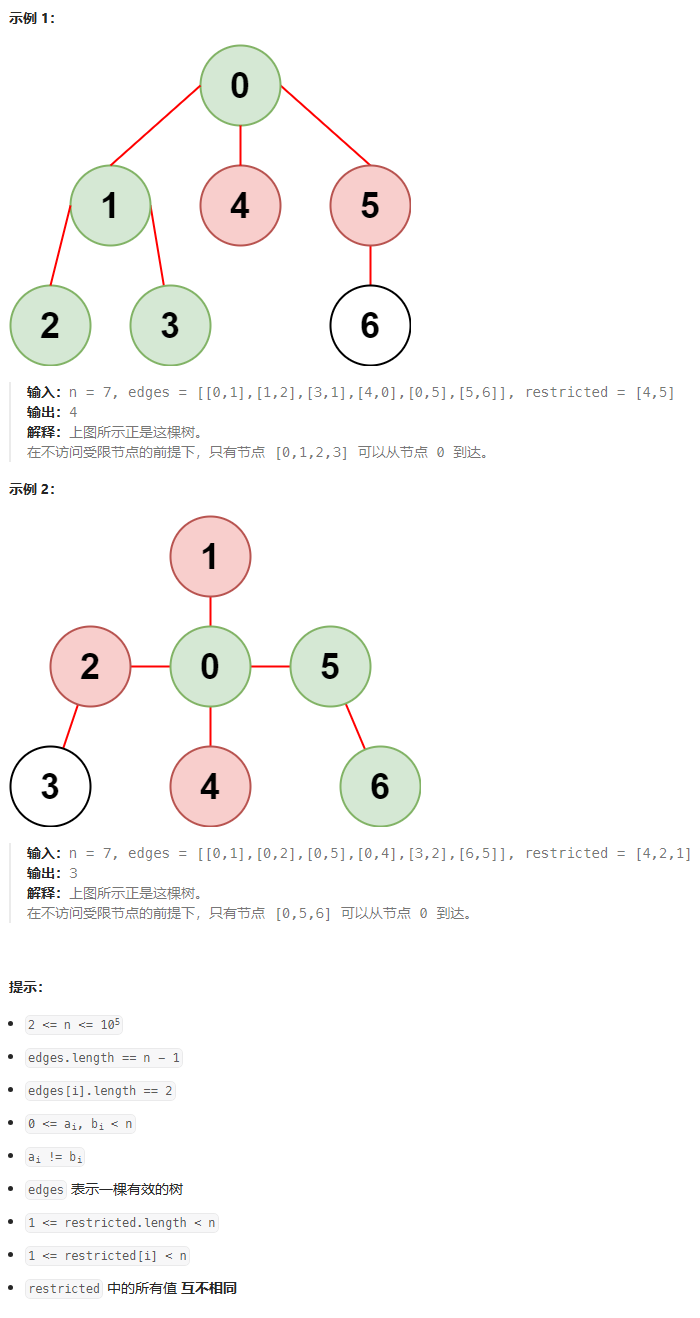
现有一棵由 n 个节点组成的无向树,节点编号从 0 到 n - 1 ,共有 n - 1 条边。

给你一个二维整数数组 edges ,长度为 n - 1 ,其中 edges[i] = [ai, bi] 表示树中节点 ai 和 bi 之间存在一条边。另给你一个整数数组 restricted 表示 受限 节点。

在不访问受限节点的前提下,返回你可以从节点 0 到达的 最多 节点数目。

注意,节点 0 不 会标记为受限节点。

思路

自然的想法是构建图,将受限节点从中删除,然后深度优先遍历,同时记录节点个数。这里构建的图主要是为了获取其连通节点进行dfs,HashSet不太适合。因为数据可能并不是连续存储的,要先计算元素的Hash值,然后从桶中取出链表或者红黑树,才能找到元素。在本例中,性能会下降一倍。

代码

/**
 * @date 2024-03-02 15:39
 */
public class ReachableNodes {
    public int res = 1;
    boolean[] isRestricted;

    public int reachableNodes(int n, int[][] edges, int[] restricted) {
        List<Integer>[] g = new ArrayList[edges.length + 1];
        isRestricted = new boolean[edges.length + 1];
        for (int i : restricted) {
            isRestricted[i] = true;
        }
        for (int i = 0; i < g.length; i++) {
            g[i] = new ArrayList<>();
        }
        for (int[] edge : edges) {
            if (isRestricted[edge[0]] || isRestricted[edge[1]]) {
                continue;
            }
            g[edge[0]].add(edge[1]);
            g[edge[1]].add(edge[0]);
        }
        dfs(0, -1, g);
        return res;
    }

    public void dfs(int root, int parent, List<Integer>[] g) {
        for (Integer n : g[root]) {
            if (n == parent) {
                continue;
            }
            res++;
            dfs(n, root, g);
        }
    }
}

性能

看了官网的答案还可以使用并查集,耗时只要10ms,有时间可以看看。